8 Major Modern Art Movements You Need to Know
8 Major Modern Art Movements You Need to Know
Hello fellow art aficionados! Ever feel like stepping into a time machine and wandering through the kaleidoscope of modern art? Oh, I do! Modern art, that vibrant, sometimes bewildering, and always revolutionary landscape, holds so much to explore. It's a wild garden of creativity where rules are bent, traditions are questioned, and new visual languages are born.
So, grab your imaginary beret, and let's embark on a whirlwind tour of eight major modern art movements. Prepare to have your artistic senses tingled! We'll journey from the dawn of the 20th century, witnessing the birth of styles that continue to inspire and challenge us today.
1. Fauvism: The Wild Beasts of Color

Imagine walking into a gallery and being greeted by a riot of color! Pure, unadulterated, unapologetic color. That's Fauvism for you. Emerging in the early 1900s, this movement, whose name translates to "wild beasts," rejected the subdued palettes of Impressionism. Henri Matisse, André Derain, and Maurice de Vlaminck, among others, dared to unleash vibrant, non-naturalistic colors onto their canvases.
Think oranges so bright they practically vibrate, blues that scream from the depths of the ocean, and greens that feel utterly electric. Fauvist painters prioritized emotion over realism. They didn't just see a tree as green; they felt it as emerald, chartreuse, even a dazzling cerulean. It was all about the expressive power of color, a raw and exhilarating declaration of artistic freedom.
Key characteristics of Fauvism:
- Intense, non-naturalistic colors: This is the hallmark of Fauvism. Colors were chosen for their emotional impact, not necessarily to accurately represent reality.
- Simplified forms: Fauvist artists often simplified their subject matter, focusing on the essence of the form rather than intricate details.
- Bold brushstrokes: The application of paint was often loose and expressive, adding to the overall sense of energy and spontaneity.
- Emphasis on emotion: Fauvism was about expressing the artist's feelings and perceptions, rather than creating a photographic representation of the world.
Think of Matisse's "Woman with a Hat" – a painting that caused quite a stir at the time but now stands as a testament to the sheer audacity and beauty of Fauvism!
2. Expressionism: Screaming from the Soul

If Fauvism was about the wild joy of color, Expressionism delved into the depths of human emotion. Emerging in Germany in the early 20th century, this movement was a response to the growing anxieties and alienation of modern life. Expressionist artists sought to express their inner turmoil, fears, and anxieties through distorted forms, jarring colors, and emotionally charged subject matter.
Think of Edvard Munch's "The Scream," perhaps the most iconic image of existential angst ever created. Expressionist artists weren't interested in depicting the world as it appeared but as it felt. They used art as a vehicle to explore the darker side of the human psyche, to confront uncomfortable truths, and to give voice to the unspoken anxieties of their time.
Key characteristics of Expressionism:
- Distortion of form: Expressionist artists often distorted the human figure and other objects to convey a sense of unease and emotional intensity.
- Exaggerated colors: Like the Fauves, Expressionists used color expressively, but often in darker, more unsettling tones.
- Emotional intensity: Expressionist art is characterized by a strong sense of emotion, whether it be fear, anxiety, despair, or rage.
- Focus on the inner self: Expressionist artists were primarily concerned with expressing their own inner experiences and emotions.
Artists like Ernst Ludwig Kirchner, Emil Nolde, and Wassily Kandinsky (in his early, more figurative work) were all key figures in the Expressionist movement, each with their own unique way of translating raw emotion onto canvas. It's a powerful, sometimes unsettling, but always deeply moving experience.
3. Cubism: Seeing the World in Fragments

Prepare for a mental workout! Cubism, pioneered by Pablo Picasso and Georges Braque, revolutionized the way we see the world. Forget perspective and realism; Cubism aimed to represent objects from multiple viewpoints simultaneously. Imagine taking an object, shattering it into fragments, and then reassembling those fragments on a single canvas.
That's essentially what Cubist artists did. They broke down objects into geometric shapes, analyzed them from different angles, and then pieced them back together in a way that challenged traditional notions of representation. It was a radical departure from the past, a bold attempt to capture the complexity and multi-dimensionality of reality.
There are two main phases of Cubism: Analytical Cubism and Synthetic Cubism. Analytical Cubism (think Picasso's "Les Demoiselles d'Avignon") involved a more fragmented and monochromatic approach, while Synthetic Cubism (think collages incorporating real-world objects) was more colorful and decorative.
Key characteristics of Cubism:
- Fragmentation: Objects are broken down into geometric shapes and fragments.
- Multiple perspectives: Objects are shown from multiple viewpoints simultaneously.
- Abstraction: Cubist art is highly abstract, often difficult to recognize the original subject matter.
- Geometric forms: Shapes like cubes, cones, and cylinders are frequently used to represent objects.
Cubism wasn't just about painting; it influenced sculpture, architecture, and design, forever changing the landscape of modern art.
4. Futurism: The Speed and Thrill of the Machine Age

Buckle up! Futurism was an Italian artistic and social movement that celebrated speed, technology, and the dynamism of the modern world. Born in the early 20th century, Futurists rejected the past and embraced the future with unbridled enthusiasm. They glorified machines, automobiles, airplanes, and all things fast and modern.
Think of Umberto Boccioni's "Unique Forms of Continuity in Space," a bronze sculpture that captures the sense of movement and energy that defined Futurism. Futurist paintings often depicted scenes of urban life, industrial landscapes, and the excitement of technological progress. They used fragmented forms, dynamic lines, and vibrant colors to convey a sense of speed and motion.
Key characteristics of Futurism:
- Emphasis on speed and motion: Futurists sought to capture the dynamism and energy of the modern world.
- Celebration of technology: Futurism glorified machines, automobiles, and other technological innovations.
- Fragmented forms: Like Cubists, Futurists used fragmented forms to convey a sense of movement and disruption.
- Rejection of the past: Futurists believed that the past was obsolete and that art should embrace the future.
While Futurism's celebration of technology and war can be problematic from a modern perspective, its impact on art and design is undeniable. It was a movement that captured the spirit of a rapidly changing world, for better or for worse.
5. Dada: Art as Anti-Art

Prepare to question everything you thought you knew about art! Dada was an anti-art movement that emerged in Zurich, Switzerland, during World War I. Dadaists rejected logic, reason, and all the traditional values that had led to the horrors of the war. They embraced absurdity, irrationality, and the nonsensical as a form of protest against the established order.
Think of Marcel Duchamp's "Fountain," a urinal presented as a work of art. Dada challenged the very definition of art, questioning its purpose and its value. Dadaists used collage, assemblage, and performance art to create works that were often shocking, provocative, and intentionally meaningless. They sought to dismantle traditional artistic conventions and to create a new form of art that reflected the chaos and absurdity of the modern world.
Key characteristics of Dada:
- Rejection of logic and reason: Dadaists embraced absurdity, irrationality, and the nonsensical.
- Anti-art stance: Dada challenged the very definition of art and its purpose.
- Use of collage and assemblage: Dadaists often used found objects and unconventional materials to create their works.
- Provocative and shocking imagery: Dada art was often intended to shock and challenge the viewer.
Dada paved the way for Surrealism and other avant-garde movements that continued to question the nature of art and its role in society. It's a reminder that art can be anything we want it to be, even nothing at all!
6. Surrealism: Dreams and the Unconscious

Enter the realm of dreams! Surrealism, emerging from the ashes of Dada, explored the realm of the unconscious mind. Inspired by the theories of Sigmund Freud, Surrealist artists sought to tap into the power of dreams, fantasies, and irrational thoughts. They created bizarre and dreamlike imagery, often juxtaposing unexpected objects and creating illogical scenarios.
Think of Salvador Dalí's "The Persistence of Memory," with its melting clocks and desolate landscape. Surrealist artists like René Magritte, Joan Miró, and Max Ernst used a variety of techniques, including automatism (spontaneous creation without conscious control) and collage, to create works that were both unsettling and strangely beautiful. It's an invitation to explore the hidden depths of our minds, to embrace the illogical, and to find beauty in the unexpected.
Key characteristics of Surrealism:
- Exploration of the unconscious mind: Surrealist artists sought to tap into the power of dreams, fantasies, and irrational thoughts.
- Dreamlike imagery: Surrealist art is characterized by bizarre and dreamlike imagery.
- Juxtaposition of unexpected objects: Surrealists often combined seemingly unrelated objects in unexpected ways.
- Automatism: Some Surrealist artists used automatism to create works spontaneously, without conscious control.
Surrealism wasn't just a visual art movement; it also influenced literature, film, and other creative fields. It's a reminder that the most fascinating art often comes from the depths of our subconscious.
7. Abstract Expressionism: Painting as Action
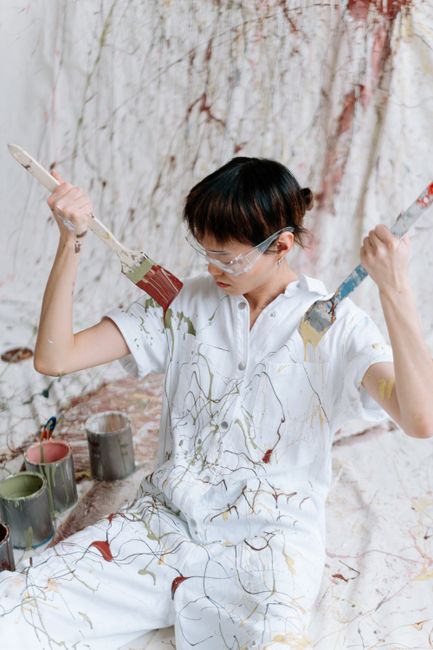
Get ready for some action! Abstract Expressionism, which flourished in the United States after World War II, was a movement that emphasized spontaneity, gesture, and the act of painting itself. Abstract Expressionist artists rejected traditional subject matter and focused on expressing their inner emotions through abstract forms and colors.
Think of Jackson Pollock's drip paintings, created by flinging and pouring paint onto a canvas laid on the floor. Abstract Expressionism was about the process of creation, the energy and physicality of the artist's movements. Artists like Mark Rothko, Barnett Newman, and Willem de Kooning created large-scale canvases that were intended to overwhelm the viewer and to evoke a sense of awe and emotional intensity.
Key characteristics of Abstract Expressionism:
- Emphasis on spontaneity and gesture: Abstract Expressionist artists emphasized the act of painting itself, often using spontaneous and gestural techniques.
- Abstract forms and colors: Abstract Expressionist art is characterized by abstract forms and colors, rather than representational imagery.
- Large-scale canvases: Abstract Expressionist paintings were often large in scale, intended to overwhelm the viewer.
- Emphasis on emotional expression: Abstract Expressionism was about expressing the artist's inner emotions through abstract forms and colors.
Abstract Expressionism shifted the center of the art world from Paris to New York and established the United States as a major force in modern art.
8. Pop Art: Celebrating the Everyday

Finally, let's dive into the world of Pop Art! Emerging in the 1950s and 1960s, Pop Art celebrated popular culture, consumerism, and mass media. Pop artists drew inspiration from advertising, comic books, and everyday objects, elevating them to the status of art. It was a playful and ironic response to the high art of Abstract Expressionism.
Think of Andy Warhol's Campbell's Soup Cans, a series of screenprints that transformed a mundane supermarket item into an iconic work of art. Pop artists like Roy Lichtenstein, Claes Oldenburg, and James Rosenquist used bold colors, graphic imagery, and mass-production techniques to create works that were accessible, engaging, and often humorous. It's a celebration of the everyday, a reminder that art can be found in the most unexpected places.
Key characteristics of Pop Art:
- Celebration of popular culture: Pop Art drew inspiration from advertising, comic books, and other aspects of popular culture.
- Use of bold colors and graphic imagery: Pop Art is characterized by bold colors, graphic imagery, and mass-production techniques.
- Irony and humor: Pop Art often used irony and humor to comment on consumerism and mass media.
- Accessibility: Pop Art was intended to be accessible to a wide audience, rather than elitist or exclusive.
Pop Art blurred the boundaries between high art and popular culture, forever changing the way we think about art and its relationship to the world around us.
And there you have it! A whirlwind tour through eight major modern art movements. I hope this little journey has sparked your curiosity and inspired you to explore the vast and fascinating world of modern art. Each movement offers a unique perspective on the world, a different way of seeing, feeling, and expressing ourselves. So, go forth, explore, and let your artistic soul soar!
Post a Comment